The three pillars: Direction, Levels and Time of Day
Most trading tools live on your chart. They show you what price is doing right now — and leave you to work out what it means.
But the hardest part of a trading day isn't reading the chart in the moment. It's the decision you make before the session starts, often before you've seen a single bar: how am I going to approach today? Most traders answer that question with a glance at price and a hope that the market cooperates. By the time it's clear it isn't a trend day — it's a chop day — the damage is done.
FlowState Pro is built around a simple idea: every trading session should start with three things understood, not three things assumed. Three pillars — Direction, Levels, and Timing. Get those straight before the open, and you trade with context instead of guesswork.
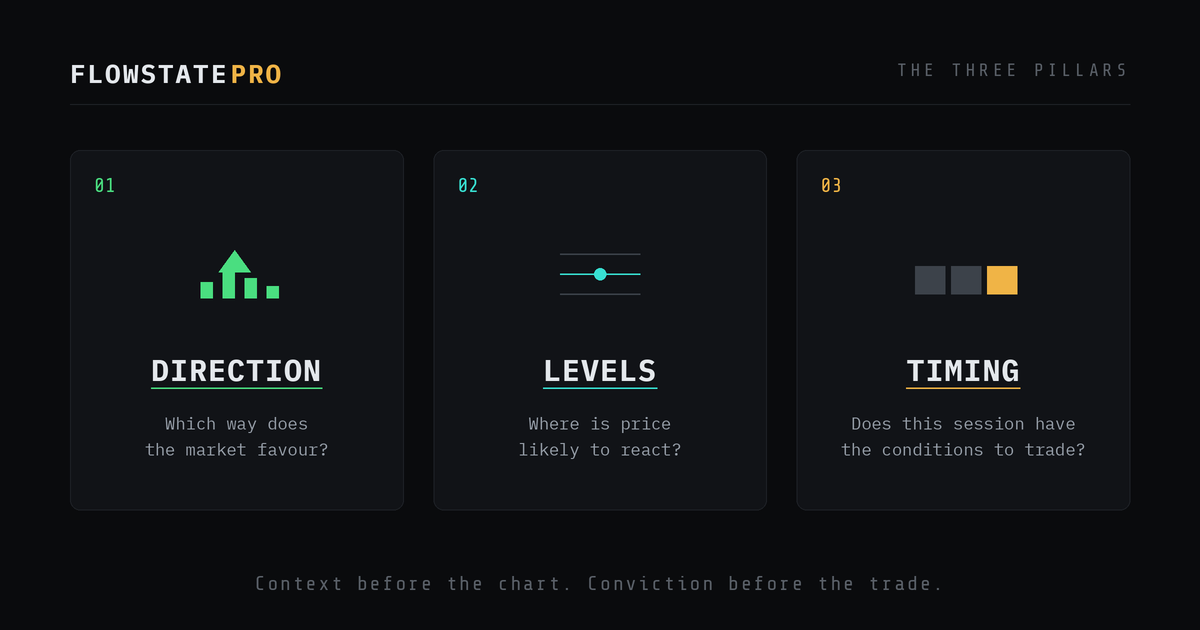
Here's what each pillar means, and why it matters.
Direction — which way does the market favour?
The first question isn't "will it go up or down" — nobody knows that. The useful question is: what kind of market is this, and which way is it leaning?
That's what regime classification answers. A market in TREND EXPANSION behaves nothing like one that's RANGING, which behaves nothing like one in MEAN REVERSION. The same setup — say, price pushing into a key level — is a breakout in one regime and a fade in another. Trade the right setup in the wrong regime and you still lose.
FlowState Pro classifies the regime before the session opens and attaches a live confidence score to the call. It tracks session bias across Asia, London, and NY — because the day has a structure. Asia sets the tone. London confirms or reverses it. NY follows, or breaks, what came before. Knowing the regime and the bias indicates how to size, when to hold, and — just as importantly — when to stand aside.
Direction isn't a prediction. It's a read on the conditions you're about to trade into.
Levels — where is price likely to react?
If direction tells you the character of the day, levels tell you where the day's decisions get made.
Price doesn't move in a vacuum. It reacts at structure: the previous day's high and low, the value area (VAH, VAL, POC), the initial balance, overnight session highs and lows, weekly levels. These are the places where other participants have already decided something matters — so they're where reactions cluster.
FlowState Pro surfaces these levels with live distance from current price, so you can see at a glance what's near and what's far. It shows initial balance size relative to the average daily range, so you immediately know whether today's range is tight or already stretched. And it does this in your instrument's price — futures or cash — with the basis shown live, so a level is never ambiguous.
The point isn't to give you more lines on a chart. It's to tell you, before you size in, where the session is likely to turn — so you're waiting for the reaction instead of chasing the move.
Timing — does this session have the conditions to trade?
The third question is the one most tools ignore entirely: is now even the time?
A futures day isn't one continuous market. It's a sequence of sessions, each with its own character — Asia, London, pre-market, NY — and each handing off to the next. A breakout late in a session that's already consumed most of its average range is a very different proposition from the same breakout early, with room left to run. Time of day changes the meaning of everything else.
FlowState Pro reads the session in structure, not just price. How much of the average range has been used. Whether the initial balance has formed. What the prior sessions did and whether this one is confirming or diverging. It surfaces this as a plain-language read of where you are in the day — so you know whether the conditions favour a trade, or whether the smart move is to wait for the next session to set up.
Timing is what stops a good direction read and a clean level from turning into a bad trade taken at the wrong moment.
Three pillars, one read
Most tools give you one of these. A charting indicator gives you a level. An order-flow tool gives you the moment of execution. Historical-probability tools tell you what used to happen at a level.
FlowState Pro is built on all three — direction, levels, timing — surfaced before you open a chart, and updated through the session as conditions change. Because the right setup, at the wrong level, in the wrong session, is still a losing trade.
Context before the chart. Conviction before the trade. That's where the edge starts — before the open.